Article number: "1"
Article ID: "999999999" (id "a999999999" and role "")
DOI: "10.1234/XXX-123456789"
Document type: "Original"
Publisher imprint: "The Imprint"
Year of publication: "2004"
Copyright Taylor & Francis: "yes"
Copyright owner: "TF"
Product free: "no"
Number of colour pages: "0"
Tagger: "Detica"
Primary Language: "en"
Article ID: "999999999" (id "a999999999" and role "")
DOI: "10.1234/XXX-123456789"
Document type: "Original"
Publisher imprint: "The Imprint"
Year of publication: "2004"
Copyright Taylor & Francis: "yes"
Copyright owner: "TF"
Product free: "no"
Number of colour pages: "0"
Tagger: "Detica"
Primary Language: "en"
Contents:
Sample T&F Journal Article (Article Title) >>>
Title of Abstract >>>
. This abbrev is at start of article. The Abbreviation Section >>>
. This nomen is at start of article. The Nomenclature Section >>>
Introduction Title >>>
Article Structure (Part Title) >>>
. First Section in Part 1 (Section 1 Title) >>>
. Second Section in Part 1 (Section 1 Title) >>>
. . First Sub-Section (Section 2 Title) >>>
. . Second Sub-Section (Section 2 Title) >>>
. . . A Sub-Sub-Section (title) >>>
. . . . A Sub-Sub-Sub-Section (title) >>>
. . . . . A Sub-Sub-Sub-Sub-Section (title) >>>
. Inline Elements >>>
. Text Blocks >>>
Sidebox Title >>>
Index Title >>>
A >>>
Subjects and Compound Entries >>>
See Other Entries >>>
Sub groupings >>>
. . Old Sidebox >>>
. Text Blocks Within Text >>>
. Lists >>>
. Tables >>>
. . Tables In File "999999999_suppl.xml" >>>
. Images and Media >>>
. Maths and Chemistry >>>
. The Summary >>>
. Some Notes Added in Proof >>>
. The Glossary >>>
. The Abbreviation Section >>>
. The Nomenclature Section >>>
. The References >>>
. . Reference Section >>>
. . These are "readings" >>>
First Additional Abstract >>>
An Additional Title >>>
Second Additional Abstract >>>
French Translation Title >>>
Formal Tables:
Title Of Table One - (these titles are optional in formal tables) >>>
Figures:
Figure Title - Image (fig. 1) >>>
All Elements: (alphabetically ordered - links to first occurrences)
abbrev-sect >>> abbrevtitle >>> abstract >>> abstractnum >>> ackno >>> acronym >>> addline >>> addnote >>> address >>> address-text >>> affiliation >>> affiliations >>> affiltitle >>> answer >>> article >>> articletitle >>> author >>> authorfield >>> authornote >>> author-ref >>> author-ref-text >>> b >>> biography >>> bioinfo >>> booktitle >>> box >>> br >>> caption >>> category >>> chaptitle >>> chemeqn >>> chemeqnref >>> chemformref >>> chemobj >>> chemstructureref >>> citationref >>> city >>> closing >>> coden >>> collectworktitle >>> colspec >>> comment >>> companyname >>> compound >>> computertext >>> contact >>> contactinfo >>> corporate >>> country >>> date >>> day >>> defentry >>> definition >>> deflist >>> degree >>> department >>> docpubdate >>> docpubtitle >>> doi >>> doititle >>> editorfield >>> editor-ref >>> editor-ref-text >>> email >>> endnote >>> endnoteref >>> endnotes >>> entry >>> enunciation >>> enunciationref >>> equation >>> etal >>> exam >>> extract >>> famousname >>> fax >>> figure >>> figureref >>> firstpage >>> footnote >>> footnoteref >>> formaltable >>> formula >>> fundawardid >>> fundingaward >>> fundingdetails >>> fundingrecipient >>> fundingsource >>> givenname >>> glossary >>> graphic >>> honorific >>> i >>> index >>> indexdiv >>> indexentry >>> indexsubentry >>> indxname >>> indxsubj >>> informaltable >>> inits >>> inlinechemeqn >>> inlinegraphic >>> inlinematheqn >>> institution >>> institutionname >>> internat >>> intro >>> issn >>> issue >>> itemizedlist >>> journalcode >>> journalsubtitle >>> journaltitle >>> keyword >>> keywordset >>> label >>> lastpage >>> letter >>> listitem >>> listitemref >>> listref >>> logo >>> mathcompound >>> matheqn >>> matheqnref >>> meetingdate >>> meetingfield >>> meetingloc >>> meetingname >>> meta >>> middlename >>> month >>> name >>> newpage >>> no >>> nomen-sect >>> notesaddedinproof >>> orderedlist >>> overline >>> pagefield >>> para >>> part >>> patentnum >>> patentowner-ref-text >>> patenttitle >>> periodicpubfield >>> phone >>> photo >>> poem >>> poemline >>> position >>> postalcode >>> prefix >>> presentationtitle >>> primarysubcategory >>> principalinvestigator >>> production-dates >>> pubfield >>> pubitemid >>> publicationfield >>> publicationfield-text >>> pubmedabbrev >>> pubname >>> pubnum >>> pubplace >>> query >>> question >>> question-answer >>> readings >>> ref-book >>> ref-book-text >>> ref-conf >>> ref-conf-text >>> references >>> ref-govpub >>> ref-govpub-text >>> ref-patent >>> ref-patent-text >>> ref-periodic >>> ref-periodic-text >>> refsection >>> ref-web >>> ref-web-text >>> roman >>> row >>> salutation >>> script >>> search >>> section1 >>> section2 >>> section3 >>> section4 >>> section5 >>> seealsoie >>> seeie >>> seriesinfo >>> shortauthors >>> shortsectionhead >>> shorttitle >>> sici >>> signature >>> simplelist >>> smallcaps >>> source >>> stanza >>> state >>> strikethrough >>> structure >>> sub >>> subcategory >>> subject >>> subtitle >>> subtopic >>> suffix >>> summary >>> sup >>> supertitle >>> supplementfile >>> supplementmaterial >>> suppmatref >>> surname >>> table >>> tableref >>> tbody >>> term >>> terminology >>> textref >>> tgroup >>> title >>> topic >>> trademark >>> translation >>> tt >>> u >>> unnumchemeqn >>> unnummatheqn >>> usa >>> volume >>> volumenum >>> webaddress >>> xref >>> year >>> zip >>>
Elements with Identifiers:
article :
- 'a999999999'
query : - 'Q0001' - 'Q0002' - 'Q0003'
affiliation : - 'AFF0001' - 'AFF0002'
supplementmaterial : - 'suppmat1' - 'suppmat2' - 'suppmat3' - 'suppmat4'
para : - 'P1'
computertext : - 'comptext1'
extract : - 'extract1' - 'extract2' - 'extract3'
indexentry : - 'targetEntry1' - 'targetEntry2'
enunciation : - 'enunciation1'
footnote : - 'footnote1'
simplelist : - 'list1'
listitem : - 'listitem1'
formaltable : - 'table1'
figure : - 'figure1'
endnotes : - 'endnote1'
matheqn : - 'matheqn1' - 'matheqn2'
chemeqn : - 'chemeqn1'
formula : - 'chemform1'
structure : - 'chemstruct1'
fundingsource : - 'FS0001'
endnote : - 'endnt1' - 'endnt2'
references : - 'references'
ref-periodic : - 'loosePeriodic' - 'realPeriodic'
ref-book : - 'looseBook' - 'realBook' - 'realBookCorp'
ref-book-text : - 'looseBook2'
ref-conf : - 'looseConference' - 'realConference'
ref-govpub : - 'looseGovPub'
ref-patent : - 'loosePatent'
ref-web : - 'looseWeb'
query : - 'Q0001' - 'Q0002' - 'Q0003'
affiliation : - 'AFF0001' - 'AFF0002'
supplementmaterial : - 'suppmat1' - 'suppmat2' - 'suppmat3' - 'suppmat4'
para : - 'P1'
computertext : - 'comptext1'
extract : - 'extract1' - 'extract2' - 'extract3'
indexentry : - 'targetEntry1' - 'targetEntry2'
enunciation : - 'enunciation1'
footnote : - 'footnote1'
simplelist : - 'list1'
listitem : - 'listitem1'
formaltable : - 'table1'
figure : - 'figure1'
endnotes : - 'endnote1'
matheqn : - 'matheqn1' - 'matheqn2'
chemeqn : - 'chemeqn1'
formula : - 'chemform1'
structure : - 'chemstruct1'
fundingsource : - 'FS0001'
endnote : - 'endnt1' - 'endnt2'
references : - 'references'
ref-periodic : - 'loosePeriodic' - 'realPeriodic'
ref-book : - 'looseBook' - 'realBook' - 'realBookCorp'
ref-book-text : - 'looseBook2'
ref-conf : - 'looseConference' - 'realConference'
ref-govpub : - 'looseGovPub'
ref-patent : - 'loosePatent'
ref-web : - 'looseWeb'
Metadata
Product ID: "productID"
Article status: ""
MedLine journal title: ""
Content type: ""
Special issue: "yes" (title "This is a Special Issue Title")
Article URL: ""
Volume number: "2"
Issue number: "3" (sequence "1") (in press "")
Page range: "12" - "15" (total "")
PDF file: "" (size "") (pages "")
Full text link: ""
Colour graphics: "no"
Audience: "" (secondary "")
Reference style: "Math"
Article status: ""
MedLine journal title: ""
Content type: ""
Special issue: "yes" (title "This is a Special Issue Title")
Article URL: ""
Volume number: "2"
Issue number: "3" (sequence "1") (in press "")
Page range: "12" - "15" (total "")
PDF file: "" (size "") (pages "")
Full text link: ""
Colour graphics: "no"
Audience: "" (secondary "")
Reference style: "Math"
journalcode
:
 XYZ
XYZ
XYZissn
:
0092-1234
0092-1234issn
:
1532-9876
1532-9876coden
:
Coden text
Coden textsici
:
A-999
A-999pubitemid
:
S0001-9999(00)00100-3
S0001-9999(00)00100-3pubmedabbrev
:
PUBMED Abbreviation
PUBMED Abbreviationauthor
:
name
:
HonorificPrefixGivennameASurnameSuffixDegree1Degree2Query Q0001: This a query requesting a correction to the author's name.
HonorificPrefixGivennameASurnameSuffixDegree1Degree2Query Q0001: This a query requesting a correction to the author's name.contactinfo
:
contact
:
Affiliation Title[email protected]+99 (0) 123 456 7890+99 (0) 123 456 7899www.FirstContact.org
Affiliation Title[email protected]+99 (0) 123 456 7890+99 (0) 123 456 7899www.FirstContact.orgcontact
:
Contact Address Line OneContact Address Line TwoContact CityContact StateZip CodeContact Country+99 (0) 123 456 7890 +99 (0) 123 456 7899[email protected]www.SecondContact.orgAdditional Note on Address
Contact Address Line OneContact Address Line TwoContact CityContact StateZip CodeContact Country+99 (0) 123 456 7890 +99 (0) 123 456 7899[email protected]www.SecondContact.orgAdditional Note on Address
bioinfo
:
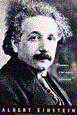
biography
:
First biography paragraph.
Second biography paragraph.
First biography paragraph.Second biography paragraph.authornote
:
Author note (type not specified).
Author note (type not specified).authornote
:
Author note (type: "member" of something).
Author note (type: "member" of something).author
:
name
:
SecondaryAuthor
SecondaryAuthorcontactinfo
:
contact
:
Affiliation Title[email protected]+99 (0) 123 456 7890+99 (0) 123 456 7899www.FirstContact.org
Affiliation Title[email protected]+99 (0) 123 456 7890+99 (0) 123 456 7899www.FirstContact.orgcontact
:
Contact Address Line OneContact Address Line TwoContact CityContact StateZip CodeContact Country+99 (0) 123 456 7890 +99 (0) 123 456 7899[email protected]www.SecondContact.orgAdditional Note on AddressQuery Q0002: This is a query for correction added to an affiliation USA-formatted address.
Contact Address Line OneContact Address Line TwoContact CityContact StateZip CodeContact Country+99 (0) 123 456 7890 +99 (0) 123 456 7899[email protected]www.SecondContact.orgAdditional Note on AddressQuery Q0002: This is a query for correction added to an affiliation USA-formatted address.
affiliations
:
affiliation
:
Institution NameDepartment
International Address LineCityPost Code Countrywww.detica.comFirst Address NoteSecond Address NoteQuery Q0003: This is a query for correction added to an affiliation address.
Institution NameDepartment
International Address LineCityPost Code Countrywww.detica.comFirst Address NoteSecond Address NoteQuery Q0003: This is a query for correction added to an affiliation address.
affiliation
:
Another InstitutionUSA CityStateUSA
Another InstitutionUSA CityStateUSA
fundingdetails
:
fundingaward
:
Taylor & Francis Group
ABCD
1234
Taylor & Francis Group
ABCD
1234
fundingrecipient
:
Department of TaggingMetadata University
name
:
Dr.MarkSign
Dr.MarkSignDepartment of TaggingMetadata Universityprincipalinvestigator
:
name
:
Dr.MarkSign
Dr.MarkSign<-- <relatedmaterial relatedas="followup" relationtype="errata" articleid="262358" doi="10.1080/10428190701625081">
<ref-periodic id="REL0001"><authorfield><author-ref><surname>Au</surname>
<givenname>Wing-Yan</givenname></author-ref><author-ref><surname>Tam</surname>
<givenname>Sidney</givenname></author-ref><author-ref><surname>Fong</surname>
<givenname>Bonnie</givenname><middlename>M.</middlename></author-ref><author-ref><etal />
</author-ref></authorfield><articletitle>Prolonged oral arsenic trioxide therapy and neprholithiasis</articletitle>
<journaltitle>Leukemia and Lymphoma</journaltitle><periodicpubfield><year>2007</year>
<volume>48</volume><issue>11</issue></periodicpubfield><pagefield><firstpage>2233</firstpage>
<lastpage>2234</lastpage></pagefield><doi>10.1080/10428190701625081</doi></ref-periodic>
<relationnote>While we don't like to have errata, they sometimes are needed.</relationnote>
</relatedmaterial> -->
supplementmaterial
:

search
:
MajorCategoryKeyword
PrimarySubCategoryKeyword
SubCategoryKeyword
SecondSubCategoryKeyword
TopicKeyword
SubTopicKeyword
AnotherSubTopicKeyword
MajorCategoryKeyword
PrimarySubCategoryKeyword
SubCategoryKeyword
SecondSubCategoryKeyword
TopicKeyword
SubTopicKeyword
AnotherSubTopicKeyword
production-dates
:
This is a comment. Such comments in this test article will be used where it is not feasible to put self-describing text into a structure.This is a comment about the metadata. Several comments can appear, but only at the end of the metadata sectionThis article XML last modified: $Date: 2011-10-28 09:35:10 -0400 (Fri, 28 Oct 2011) $ $Rev: 895 $The Journal of Test Articles (Journal Title)Test articles and test metadataTEST ARTICLE (Super Title)Sample T&F Journal Article (Article Title)Self-Describing Software-Stress-Testing Article - Conforming to Article DTD 1.8 version 1.8.0(Sub Title)Givenname A. Surname and Secondary AuthorDTD 1.8 Test Article (Short Title)Article DOI (Digital Object Identifier Title)
Abstract
Title of AbstractThis article is designed to test the "Taylor & Francis Journal Article DTD" (abbreviated to "TFJA") and to demonstrate its capabilities. It is self-describing in the sense that the content describes the markup that holds it. For example, a list item might contain the text "This is a list item". This approach helps to detect errors in software that is used to process or present the article content. Software is further "stress-tested" by the deliberate inclusion of complex and unusual combinations of elements and attributes. For example, abstracts often consist of a single paragraph, but this example abstract contains multiple paragraphs and a list (which will confuse or break a program that can only handle a single paragraph).Note that comments can be added in most locations between text blocks, but not within paragraph text. This is the second abstract paragraph, which also contains a list:
|
+
|
Item One in abstract |
|
+
|
Item Two in abstractSecond paragraph in list item |
Final paragraph in abstract.Keyword Set
Keyword OneKeyword TwoKeyword Three
Abbreviations
This abbrev is at start of article. The Abbreviation SectionNomenclature
This nomen is at start of article. The Nomenclature SectionIntroduction TitleThis is a paragraph. Note that paragraphs can contain other block-level objects, such as lists, as well as directly containing text.The introduction can contain all of the text objects that a section can contain, except that it cannot be divided into parts, sections and sub-sections.The introduction can contain tables:
Part A
Article Structure (Part Title)
First Section in Part 1 (Section 1 Title)
Short Section Header
This is a section in the first part of the article.
Second Section in Part 1 (Section 1 Title)
This second section contains sub-sections:
First Sub-Section (Section 2 Title)
This subsection is the first subsection in the second section of the first part of the article.
The next subsection is the last in this section, but contains further section levels.
Second Sub-Section (Section 2 Title)
This subsection contains three further levels of section, to the maximum possible level of section nesting (5 levels).
A Sub-Sub-Section (title)
This is subsection level three.
A Sub-Sub-Sub-Section (title)
This is subsection level four
A Sub-Sub-Sub-Sub-Section (title)
This is subsection level five. It is not possible to nest sections any further than this. However, headings for one more level could be simulated using bold text in short paragraphs.
Inline Elements
This section demonstrates the use of elements that can occur within blocks (such as titles and paragraphs).
Text can be made superscript or subscript. Other styles include overline and strikethrough.
A number of emphasis styles are allowed, including bold, italic, small caps, underline, |box|, roman, monospaced and script.
It is possible to embed an empasis element within another emphasis element, so any combination of styles can be produced, including a bold word in italic phrase, and a subscript word in underlined text, and an italic word in superscript text, among many other combinations.
An image can be inserted inline, as in , but other image-related elements should be used for special purposes, such as for figures, logos and article author photographs.
When a new page starts in the initial print publication of an article, the location of the page-break is preserved. This text appears at the end of page 2, and ... --- [page 3] --- this text appears at the start of page 3.
A paragraph can be broken into lines using the break elements, in order to include poetry:[break]
line of text one[break]
line of text two[break]
line of text three.
Note that there is a block-level element for computer text that is described later, but it is also possible to include computer code, or other lines of monospaced text, using a mixture of the break element and the monospaced emphasis element, as in :[break]
monospaced line 1[break]
monospaced line 2
Objects in the text can be isolated and identified using the "name" related elements, including famous names, company names and institution names: Einstein, IBM and NASA. A trademark such as Java can be identified. In addition, an acronym such as BBC (British Broadcasting Corporation) can be identified, as well as terms, such as XML. Names can still be identified within styled ranges of text, such as italic text with a famous person (Einstein) within it.
Text may include references to various objects within the same article. There is a different element for references to different kinds of object in the article, including: chemical equation,[break]
chemical formulae,[break]
chemical structure,[break]
citation,[break]
end note,[break]
figure,[break]
supplementary material,[break]
footnote,[break]
list item,[break]
list,[break]
math equation,[break]
table,[break]
enunciation and cross (x-ref). These links can contain superscript, subscript and emphasis, such as link-to-W3C-Web-site.
Text may also include references to external objects, including text, a Web address, www.detica.com, and emails [email protected].
Text Blocks
This section introduces the elements that construct blocks of text, including paragraphs (such as this one).
A paragraph can be indented to various levels (this is level one)
This is level two
This is level three
This is level four
This is level five
Apart from the paragraph elements containing this text, there are also several alternatives, starting with an address:
address line one[break]
address line two[break]
City Name[break]
Country Name
It is not necessary to display an address vertically. Simply leaving out the break-line elements allows for the alternative presentation:
77 Shaftesbury Avenue, London Englandtel: 0001 999 1234 or fax: 0001 999 1235, or email to [email protected] and see the Website at www.detica.com
Blocks of computer text can be isolated. Each line of the computer text is separated from other lines using the br (break) element:
line of computer text[break]
second line of computer text[break]
third line of computer text
A letter to someone:
A normal paragraph, with bold styling, serves as a title for the letter
Paragraph of letter content between salutation and closing.
An extract from another work:
This is an extract
Second paragraph of extract
By default, the extract is part of the main narrative flow, but an attribute can be set to make it an independent "side-box", as in the following example:
Sidebox Title
This extract has a sidebox value of "yes", so it not part of the main narrative flow, and can be floated to any convenient location on a page or screen.
Source of the extract
Poetry can be identified, and individual stanzas and lines of the poem isolated:
But stanza markup is optional, and redundant when there is a single stanza presented. Either way, the source
of the poem can be added at the end:
The questions and answers in an examination can be listed:
An index of simple or complex nature can be included:
Enunciations are identified:
Finally, a footnote can be defined:
Old Sidebox
The DTD has not always allowed a title element inside an extract. Two mechanisms have been used to get around this limitation:
The DTD now allows title within extract so these workarounds can be avoided. However, processing software must still support the workarounds for older content.
Text Blocks Within Text
A text block, such as an extract, can be placed within a paragraph. When placed at the end of a paragraph, there is no real difference to it appearing immediately after the paragraph, but when placed in the middle of a paragraph, it splits the paragraph into two separate text blocks. However, the first text block in the paragraph might be formatted to indicate that a new paragraph has begun (such as by indeting the first line, and putting vertical space above it), while the second will appear directly below the embedded block, as in the text beneath this extract:
This paragraph within an extract is embedded within another paragraph!
Second paragraph of embedded extract.
so this text is not really a separate paragraph, but a continuation of the original paragraph above the extracted text.
Lists
This section demonstrates the elements that are used to construct lists.
This is a simple paragraph.
A simple (bulleted/random) list consists of a number of items:
The second kind of list is an itemized list, with a prefix that can be pre-defined using the listitemlabel attribute (in this case set to the value "="):
The third kind of list is an ordered (numbered) list. By default, items are numbered using Arabic numerals:
However, this kind of numbering can be made explicit using the numeration attribute:
Alternatively, upper-case letters can be used:
or lowercase:
Roman numerals can also be used:
Lowercase Roman numerals are the final option:
An itemized list may contain multiple paragraphs and embedded lists.
A numbered list can contain other numbered lists, and rendering software must not become confused and make mistakes in numbering each outer and inner item:
The third and final kind of list is a definition list, which is useful for glossaries:
Tables
Tables In File "999999999_suppl.xml"
Tables should always now be created as an object (that could be floating).
The "table" element is deprecated, and note that the "tbl" element is the equivalent of
the CALS default "table" element.
The following table has no attributes set, so text should appear vertically in the middle,
and left justified (the frame attribute is set to "sides"). It is a "formal" table, and
has a title:
The following table tests text alignments, both horizontally and vertically (the frame attribute is set to "topbot"):
The following table tests overriding text alignments (entry overrides row, which
overrides tbody), both horizontally and vertically (the frame attribute is set to "top"):
The following table tests horizontal alignment on a given character ("." and ":"), specified
at the tgroup and colspec levels (also, multiple tgroup elements) (the frame attribute is set to "all"):
The following table tests row and column spanning cells, using the morerows attribute
and the namest and nameend attributes (the frame attribute is set to "bottom"):
Images and Media
Figures and other graphics are commonly found in articles.
There is a single inline image element, which is used here to refer to the photograph of the author of this article (Einstein himself).... All of the other images are block-level, including the photograph and logo at the top of this article, but also including:
The final place that an image can be referenced is from within a mathematical structure:
[STRUCTURE]
.
Note that the height and width can be set, in this case to 50x20 pixels:
An image that has a title, caption and reference number is really a figure:
More interesting is the DTD's support for multimedia objects, including video, audio, datasets, and other supplementary material. Supplementary material be tagged as article metadata, or placed in the flow of article text.
Maths and Chemistry
There are numerous elements for handling maths and chemistry.
A mathematical equation must be either an equation or a compound (a set of equations).
First, a single equation, containing just the fomula in text (not the possible TeX markup and graphic versions):
Now a compound, which consists of two equations:
But there is a variant of this element that indicates that it must not break the paragraph apart. This is the "inline" variant: inline math formula. Such formulae will also not be numbered.
Block level equations are usually numbered, but an alternative element can be used to create an unnumbered equation:
A chemical equation also consists of a single chemical object, or a compound of objects.
First, a single chemical object, which consists of a formula or reference to a structure image:
Now a compound formula:
But, as with mathematical formulae, a chemical formulae can be officially "inline", using a different element: inline chemical formula. Again, such formula will not be numbered.
Block chemical equations are usually numbered, but a different element is used to create an unnumbered equation:
A structure is represented by an image of the structure, referenced by file name or by entity reference:
[STRUCTURE]
Article Structure (Part Title)
Issue number: ""
Article ID: ""
DOI: ""
Type: ""
Year of publication: ""
Colour graphics: "no"
Page range: "" - "" (total "")
Full text link: ""
Sect 1
Article ID: ""
DOI: ""
Type: ""
Year of publication: ""
Colour graphics: "no"
Page range: "" - "" (total "")
Full text link: ""
First Section in Part 1 (Section 1 Title)Short Section HeaderThis is a section in the first part of the article.
Issue number: ""
Article ID: ""
DOI: ""
Type: ""
Year of publication: ""
Colour graphics: "no"
Page range: "" - "" (total "")
Full text link: ""
Article ID: ""
DOI: ""
Type: ""
Year of publication: ""
Colour graphics: "no"
Page range: "" - "" (total "")
Full text link: ""
Second Section in Part 1 (Section 1 Title)This second section contains sub-sections:
Issue number: ""
Article ID: ""
DOI: ""
Type: ""
Year of publication: ""
Colour graphics: "no"
Page range: "" - "" (total "")
Sect 1.2
Article ID: ""
DOI: ""
Type: ""
Year of publication: ""
Colour graphics: "no"
Page range: "" - "" (total "")
First Sub-Section (Section 2 Title)This subsection is the first subsection in the second section of the first part of the article.The next subsection is the last in this section, but contains further section levels.
Issue number: ""
Article ID: ""
DOI: ""
Type: ""
Year of publication: ""
Colour graphics: "no"
Page range: "" - "" (total "")
Article ID: ""
DOI: ""
Type: ""
Year of publication: ""
Colour graphics: "no"
Page range: "" - "" (total "")
Second Sub-Section (Section 2 Title)This subsection contains three further levels of section, to the maximum possible level of section nesting (5 levels).A Sub-Sub-Section (title)This is subsection level three.A Sub-Sub-Sub-Section (title)This is subsection level fourA Sub-Sub-Sub-Sub-Section (title)This is subsection level five. It is not possible to nest sections any further than this. However, headings for one more level could be simulated using bold text in short paragraphs.
Issue number: ""
Article ID: ""
DOI: ""
Type: ""
Year of publication: ""
Colour graphics: "no"
Page range: "" - "" (total "")
Full text link: ""
Article ID: ""
DOI: ""
Type: ""
Year of publication: ""
Colour graphics: "no"
Page range: "" - "" (total "")
Full text link: ""
Inline ElementsThis section demonstrates the use of elements that can occur within blocks (such as titles and paragraphs).Text can be made superscript or subscript. Other styles include overline and strikethrough.A number of emphasis styles are allowed, including bold, italic, small caps, underline, |box|, roman, monospaced and script.It is possible to embed an empasis element within another emphasis element, so any combination of styles can be produced, including a bold word in italic phrase, and a subscript word in underlined text, and an italic word in superscript text, among many other combinations.An image can be inserted inline, as in , but other image-related elements should be used for special purposes, such as for figures, logos and article author photographs.When a new page starts in the initial print publication of an article, the location of the page-break is preserved. This text appears at the end of page 2, and ... --- [page 3] --- this text appears at the start of page 3.A paragraph can be broken into lines using the break elements, in order to include poetry:[break]line of text one
[break]line of text two
[break]line of text three.
Note that there is a block-level element for computer text that is described later, but it is also possible to include computer code, or other lines of monospaced text, using a mixture of the break element and the monospaced emphasis element, as in :[break]monospaced line 1[break]monospaced line 2Objects in the text can be isolated and identified using the "name" related elements, including famous names, company names and institution names: Einstein, IBM and NASA. A trademark such as Java can be identified. In addition, an acronym such as BBC (British Broadcasting Corporation) can be identified, as well as terms, such as XML. Names can still be identified within styled ranges of text, such as italic text with a famous person (Einstein) within it.Text may include references to various objects within the same article. There is a different element for references to different kinds of object in the article, including: chemical equation,[break]chemical formulae,[break]chemical structure,[break]citation,[break]end note,[break]figure,[break]supplementary material,[break]footnote,[break]list item,[break]list,[break]math equation,[break]table,[break]enunciation and cross (x-ref). These links can contain superscript, subscript and emphasis, such as link-to-W3C-Web-site.Text may also include references to external objects, including text, a Web address, www.detica.com, and emails [email protected].
Issue number: ""
Article ID: ""
DOI: ""
Type: ""
Year of publication: ""
Colour graphics: "no"
Page range: "" - "" (total "")
Full text link: ""
Article ID: ""
DOI: ""
Type: ""
Year of publication: ""
Colour graphics: "no"
Page range: "" - "" (total "")
Full text link: ""
Text BlocksThis section introduces the elements that construct blocks of text, including paragraphs (such as this one).A paragraph can be indented to various levels (this is level one)This is level twoThis is level threeThis is level fourThis is level fiveApart from the paragraph elements containing this text, there are also several alternatives, starting with an address:address line one[break]address line two[break]City Name[break]Country Name
It is not necessary to display an address vertically. Simply leaving out the break-line elements allows for the alternative presentation:77 Shaftesbury Avenue, London Englandtel: 0001 999 1234 or fax: 0001 999 1235, or email to [email protected] and see the Website at www.detica.com
Blocks of computer text can be isolated. Each line of the computer text is separated from other lines using the br (break) element:line of computer text[break]second line of computer text
[break]third line of computer text
A letter to someone:
A normal paragraph, with bold styling, serves as a title for the lettersalutation
:
Salutation, as in "Dear Sir," with only subscript and superscript allowed.
Salutation, as in "Dear Sir," with only subscript and superscript allowed.Paragraph of letter content between salutation and closing.closing
:
Closing text - often just a signature (by default "left" aligned, but this time "right" aligned
Closing text - often just a signature (by default "left" aligned, but this time "right" alignedsignature
:
This is my signature (could be a graphic, but if text only subscript and superscript allowed!
This is my signature (could be a graphic, but if text only subscript and superscript allowed!An extract from another work:
This is an extractSecond paragraph of extractBy default, the extract is part of the main narrative flow, but an attribute can be set to make it an independent "side-box", as in the following example:
Sidebox TitleThis extract has a sidebox value of "yes", so it not part of the main narrative flow, and can be floated to any convenient location on a page or screen.Source of the extractPoetry can be identified, and individual stanzas and lines of the poem isolated:poem
:
single line of first stanza,
single line of first stanza,
single line of first stanza,
single line of first stanza
single line of second stanza,
single line of second stanza,
single line of second stanza,
single line of second stanza
single line of first stanza,single line of first stanza,single line of first stanza,single line of first stanza
single line of second stanza,single line of second stanza,single line of second stanza,single line of second stanzaBut stanza markup is optional, and redundant when there is a single stanza presented. Either way, the source
of the poem can be added at the end:poem
:
So, although unlisted in atlas or text-book,
Her Garden is easy to find. In no time
one reaches the gait over which is written
large: MAKE PEACE NOT WAR
W.H. Auden, 'Circe'
So, although unlisted in atlas or text-book,Her Garden is easy to find. In no timeone reaches the gait over which is writtenlarge: MAKE PEACE NOT WARW.H. Auden, 'Circe'The questions and answers in an examination can be listed:exam
:
Q: 1.What is two plus two?
Show workings
1.What is two plus two?Show workingsA: four
Because one plus one is two, twice!
fourBecause one plus one is two, twice!
Q: 2.What is the meaning of life?
2.What is the meaning of life?A: forty two
forty twoAn index of simple or complex nature can be included:index
:
Index Title
This is a subject index (not an author or miscellaneous index
The following three entries are not in a group.
index term one
index term two
index term three
A
A one
A two
A three
Subjects and Compound Entries
just a simple name
this entry is a subject
first name
second name
simple name
this subject is in the same entry as a simple name.
this entry is a subject, with a second paragraph.
Second paragraph explaining this subject
See Other Entries
target entry one
target entry two
entry with reference
entry with two references
Sub groupings
entry with sub-entry
sub-entry (level 1)
sub-sub-entry (level 2)
Index TitleThis is a subject index (not an author or miscellaneous indexThe following three entries are not in a group.index term oneindex term twoindex term three
AA oneA twoA three
Subjects and Compound Entries
just a simple name
this entry is a subject
first namesecond name
simple namethis subject is in the same entry as a simple name.
this entry is a subject, with a second paragraph.
Second paragraph explaining this subject
See Other Entries
target entry one
target entry two
entry with referenceSee ...see target entry one
see target entry one
entry with two referencesSee ...see target entry one
see target entry oneSee also ...see also target entry two
see also target entry two
Sub groupings
entry with sub-entry
sub-entry (level 1)
sub-sub-entry (level 2)Enunciations are identified:enunciation
:
Paragraph in enunciation.
Second paragraph in enunciation.
Paragraph in enunciation.Second paragraph in enunciation.Finally, a footnote can be defined:
footnote
:
This is a footnote. It is referenced using a footnote reference element.
This footnote contains a second paragraph.
. A symbol is generated automatically and is added to the footnote reference and to the footnote itself in order to link the two.
This is a footnote. It is referenced using a footnote reference element.This footnote contains a second paragraph.
Issue number: ""
Article ID: ""
DOI: ""
Type: ""
Year of publication: ""
Colour graphics: "no"
Page range: "" - "" (total "")
Article ID: ""
DOI: ""
Type: ""
Year of publication: ""
Colour graphics: "no"
Page range: "" - "" (total "")
Old Sidebox
The DTD has not always allowed a title element inside an extract. Two mechanisms have been used to get around this limitation:
|
item
|
Wrap the extract in a section element that contains a title and the extract only. |
|
item
|
Use text formatting elements to style the first para in bold. |
The DTD now allows title within extract so these workarounds can be avoided. However, processing software must still support the workarounds for older content.
Issue number: ""
Article ID: ""
DOI: ""
Type: ""
Year of publication: ""
Colour graphics: "no"
Page range: "" - "" (total "")
Full text link: ""
Article ID: ""
DOI: ""
Type: ""
Year of publication: ""
Colour graphics: "no"
Page range: "" - "" (total "")
Full text link: ""
Text Blocks Within TextA text block, such as an extract, can be placed within a paragraph. When placed at the end of a paragraph, there is no real difference to it appearing immediately after the paragraph, but when placed in the middle of a paragraph, it splits the paragraph into two separate text blocks. However, the first text block in the paragraph might be formatted to indicate that a new paragraph has begun (such as by indeting the first line, and putting vertical space above it), while the second will appear directly below the embedded block, as in the text beneath this extract:
This paragraph within an extract is embedded within another paragraph!Second paragraph of embedded extract.this text is not really a separate paragraph, but a continuation of the original paragraph above the extracted text.
Issue number: ""
Article ID: ""
DOI: ""
Type: ""
Year of publication: ""
Colour graphics: "no"
Page range: "" - "" (total "")
Full text link: ""
Article ID: ""
DOI: ""
Type: ""
Year of publication: ""
Colour graphics: "no"
Page range: "" - "" (total "")
Full text link: ""
ListsThis section demonstrates the elements that are used to construct lists.This is a simple paragraph.A simple (bulleted/random) list consists of a number of items:|
item
|
Simple list item, containing one paragraph. |
|
item
|
Longer list item, containing two paragraphs.This is the second paragraph in the item. |
|
item
|
As well as paragraphs, an item may contain other block-level elements, including embedded lists:
There may be any number of lists and paragraphs within a list item. |
|
item
|
Simple list item. |
The second kind of list is an itemized list, with a prefix that can be pre-defined using the listitemlabel attribute (in this case set to the value "="): |
=
|
Itemized list item One |
|
=
|
Itemized list item Two |
|
=
|
Itemized list item Three |
The third kind of list is an ordered (numbered) list. By default, items are numbered using Arabic numerals:|
(1)
|
Item One |
|
(2)
|
Item Two |
|
(3)
|
Item Three |
However, this kind of numbering can be made explicit using the numeration attribute:|
(1)
|
Item (1) |
|
(2)
|
Item (2) |
|
(3)
|
Item (3) |
Alternatively, upper-case letters can be used:|
(A)
|
Item (A) |
|
(B)
|
Item (B) |
|
(C)
|
Item (C) |
or lowercase:|
(a)
|
Item (a) |
|
(b)
|
Item (b) |
|
(c)
|
Item (c) |
Roman numerals can also be used:|
(I)
|
Item (I) |
|
(II)
|
Item (II) |
|
(III)
|
Item (III) |
Lowercase Roman numerals are the final option:|
(i)
|
Item (i) |
|
(ii)
|
Item (ii) |
|
(iii)
|
Item (iii) |
An itemized list may contain multiple paragraphs and embedded lists.|
(1)
|
First item - single paragraph. |
|
(2)
|
Second item - embedded simple list:
|
|
(3)
|
This outer item. |
A numbered list can contain other numbered lists, and rendering software must not become confused and make mistakes in numbering each outer and inner item:|
(1)
|
Outer Item (1). |
|
(2)
|
Outer Item (2):
|
|
(3)
|
Outer Item (3). |
The third and final kind of list is a definition list, which is useful for glossaries:
Issue number: ""
Article ID: "999999999"
DOI: ""
Type: ""
Year of publication: ""
Colour graphics: "no"
Page range: "" - "" (total "")
Full text link: ""
Article ID: "999999999"
DOI: ""
Type: ""
Year of publication: ""
Colour graphics: "no"
Page range: "" - "" (total "")
Full text link: ""
Tables
Issue number: ""
Article ID: ""
DOI: ""
Type: ""
Year of publication: ""
Colour graphics: "no"
Page range: "" - "" (total "")
Article ID: ""
DOI: ""
Type: ""
Year of publication: ""
Colour graphics: "no"
Page range: "" - "" (total "")
Tables In File "999999999_suppl.xml"Tables should always now be created as an object (that could be floating).
The "table" element is deprecated, and note that the "tbl" element is the equivalent of
the CALS default "table" element.<-- TABLE 1 - test basic table structure -->
The following table has no attributes set, so text should appear vertically in the middle,
and left justified (the frame attribute is set to "sides"). It is a "formal" table, and
has a title:formaltable
:
[1]
Title Of Table One - (these titles are optional in formal tables)
Title Of Table One - (these titles are optional in formal tables)| col: 1 ('col-1') width: 1* |
col: 2 ('col-2') width: 1* |
| Body Rows | |
|
cell 1,1
|
cell 1,2
|
|
cell 2,1. A cell is only able to contain a single paragraph of text. There cannot be an embedded table or list.
|
cell 2,2. styles in a table cell include
bold, italic, underline, script, smallcaps, subscript and superscript. |
<-- TABLE 2 - cell alignment tests (align and valign on entry element) -->
The following table tests text alignments, both horizontally and vertically (the frame attribute is set to "topbot"):informaltable
:
| col: 1 ('col-1') width: 1* |
col: 2 ('col-2') width: 1* |
col: 3 ('col-3') width: 1* |
| Body Rows | ||
|
The cells below this one are aligned horizontally and vertical in all the possible combinations...
|
This column holds a lot of text to help make middle alignments in the first column more obvious.
|
This column is added to help ensure that the second column is narrow enough to force the cell in the first column to occupy at least three lines.
|
|
Middle Left.
|
There is a lot of text here to make sure that this row spans at least three lines, and therefore shows that the
middle-left text in the previous cell really is not at the top or bottom of its cell (and is left justified). |
|
|
Top Left.
|
There is a lot of text here to make sure that this row spans at least three lines, and therefore shows that the
top-left text in the previous cell really is at the top of its cell (and is left justified). |
|
|
Bottom Left
|
There is a lot of text here to make sure that this row spans at least three lines, and therefore shows that the
bottom-left text in the previous cell really is at the bottom of its cell (and left justified). |
|
|
Middle Center
|
There is a lot of text here to make sure that this row spans at least three lines, and therefore shows that the
middle-center text in the previous cell really is in the middle (and centered). |
|
|
Top Center
|
There is a lot of text here to make sure that this row spans at least three lines, and therefore shows that the
top-center text in the previous cell really is at the top (and centered horizontally). |
|
|
Bottom Center
|
There is a lot of text here to make sure that this row spans at least three lines, and therefore shows that the
bottom-center text in the previous cell really is at the bottom (and centered horizontally). |
|
|
Middle Right
|
There is a lot of text here to make sure that this row spans at least three lines, and therefore shows that the
middle-right text in the previous cell really is in the middle (and right justified horizontally). |
|
|
Top Right
|
There is a lot of text here to make sure that this row spans at least three lines, and therefore shows that the
top-right text in the previous cell really is at the top (and right justified horizontally). |
|
|
Bottom Right
|
There is a lot of text here to make sure that this row spans at least three lines, and therefore shows that the
bottom-right text in the previous cell really is at the bottom (and right justified horizontally). |
|
<-- TABLE 3 - cell alignment overriding tests (rov, tbody and colspec) -->
The following table tests overriding text alignments (entry overrides row, which
overrides tbody), both horizontally and vertically (the frame attribute is set to "top"):informaltable
:
| col: 1 ('col-1') width: 1* |
col: 2 ('col-2') width: 1* |
col: 3 ('col-3') width: 1* |
| Body Rows | ||
|
Right (tgroup element) and Bottom (tbody element).
|
Top (entry element).
|
There is a lot of text here to make sure that
this row spans at least three lines, and therefore shows that the
cell alignments described in the other cells can really be seen to work
as advertised. Quite a lot of text is needed here to ensure that the other cells
will be large enough to show vertical alignments properly. This is the final sentence to
make this cell sufficiently large. Hope this is enough.
|
<-- TABLE 4 - cell alignment on character -->
The following table tests horizontal alignment on a given character ("." and ":"), specified
at the tgroup and colspec levels (also, multiple tgroup elements) (the frame attribute is set to "all"):informaltable
:
| col: 1 ('col-1') width: 1* |
col: 2 ('col-2') width: 1* |
| Body Rows | |
|
The cells below this one are aligned on decimal point. (align on ".")
|
The cells below this one are also aligned on decimal point,
because the align attribute is on the tgroup element. (align on ".")
|
|
123.4 (align on ".")
|
5.6789 (align on ".")
|
|
12.34 (align on ".")
|
56.789 (align on ".")
|
|
1.234 (align on ".")
|
5677.89 (align on ".")
|
|
1234 (align on ".")
|
56778.9 (align on ".")
|
|
1234.0 (align on ".")
|
567789 (align on ".")
|
| col: 1 ('col-1') width: 1* |
col: 2 ('col-2') width: 1* |
| Body Rows | |
|
Next cell is character aligned on ":"
|
abcde:f (align on ":")
|
|
Next cell is character aligned on ":"
|
abcd:ef (align on ":")
|
|
Next cell is character aligned on ":"
|
abc:def (align on ":")
|
|
Next cell is character aligned on ":"
|
ab:cdef (align on ":")
|
|
Next cell is character aligned on ":"
|
a:bcdef (align on ":")
|
<-- TABLE 5 - row and column spanning cells -->
The following table tests row and column spanning cells, using the morerows attribute
and the namest and nameend attributes (the frame attribute is set to "bottom"):informaltable
:
| col: 1 ('col-1') width: 1* |
col: 2 ('col-2') width: 1* |
col: 3 ('col-3') width: 1* |
| Body Rows | ||
|
Normal non-spanning cell.
|
Normal non-spanning cell.
|
Normal non-spanning cell.
|
|
Normal non-spanning cell.
|
This cell
spans down into the next row, using morerows="1", so should in part occupy the same horizontal space as cells in the next row down. |
Normal non-spanning cell.
|
|
Normal non-spanning cell.
|
Normal non-spanning cell (there is no entry element for the occupied cell before this one).
|
|
|
Normal non-spanning cell.
|
Normal non-spanning cell.
|
Normal non-spanning cell.
|
|
Normal non-spanning cell.
|
This cell
spans into the next column,
and there is no final entry element in this row. It refers to
the colspec elements for the second and third columns by their names. |
|
|
Normal non-spanning cell.
|
Normal non-spanning cell.
|
Normal non-spanning cell.
|
|
This cell
spans across and down (it occupies four cells in total) |
Normal non-spanning cell (and absent entry element before this one).
|
|
|
Normal non-spanning cell (and absent entry elements before this one).
|
||
|
Normal non-spanning cell.
|
Normal non-spanning cell.
|
Normal non-spanning cell.
|
Issue number: ""
Article ID: ""
DOI: ""
Type: ""
Year of publication: ""
Colour graphics: "no"
Page range: "" - "" (total "")
Full text link: ""
Article ID: ""
DOI: ""
Type: ""
Year of publication: ""
Colour graphics: "no"
Page range: "" - "" (total "")
Full text link: ""
Images and MediaFigures and other graphics are commonly found in articles. There is a single inline image element, which is used here to refer to the photograph of the author of this article (Einstein himself).... All of the other images are block-level, including the photograph and logo at the top of this article, but also including:The final place that an image can be referenced is from within a mathematical structure:
[STRUCTURE]
.Note that the height and width can be set, in this case to 50x20 pixels: An image that has a title, caption and reference number is really a figure:More interesting is the DTD's support for multimedia objects, including video, audio, datasets, and other supplementary material. Supplementary material be tagged as article metadata, or placed in the flow of article text. supplementmaterial
:
supplementmaterial
:
Issue number: ""
Article ID: ""
DOI: ""
Type: ""
Year of publication: ""
Colour graphics: "no"
Page range: "" - "" (total "")
Full text link: ""
Article ID: ""
DOI: ""
Type: ""
Year of publication: ""
Colour graphics: "no"
Page range: "" - "" (total "")
Full text link: ""
Maths and ChemistryThere are numerous elements for handling maths and chemistry.A mathematical equation must be either an equation or a compound (a set of equations). First, a single equation, containing just the fomula in text (not the possible TeX markup and graphic versions):Now a compound, which consists of two equations:But there is a variant of this element that indicates that it must not break the paragraph apart. This is the "inline" variant: inline math formula. Such formulae will also not be numbered.Block level equations are usually numbered, but an alternative element can be used to create an unnumbered equation:A chemical equation also consists of a single chemical object, or a compound of objects.First, a single chemical object, which consists of a formula or reference to a structure image:Now a compound formula:But, as with mathematical formulae, a chemical formulae can be officially "inline", using a different element: inline chemical formula. Again, such formula will not be numbered.Block chemical equations are usually numbered, but a different element is used to create an unnumbered equation:A structure is represented by an image of the structure, referenced by file name or by entity reference:
[STRUCTURE]
Summary
The SummaryThis is a summary of the article. It may contain sub-sections.Acknowledgements
This article was produced in collaboration with several individuals from Taylor & Francis, including Alex Kean, Bob Hech and Ed Cilurso.Note that acknoweldgements cannot be divided into sections and sub-sections.Articles supported by funded research may need to identify the sources of the research funding. Funding information in the text of an article can identify the organization that provided funding, and any identification numbers assigned by the organizations. Funding information should be repeated, in greater detail, in the article metadata. This article was funded by Taylor & Francis, grants ABCD and 1234.Notes Added In Proof
Some Notes Added in ProofThese are notes that were added during proofing of the article.Glossary
The GlossaryAbbreviations
The Abbreviation SectionNomenclature
The Nomenclature SectionThese endnotes indicate that this is the end of the article, and includes a list of endnotes:
[1] 1. Formal endnote one[2] 2. Formal endnote twoReferences
Article association: "a999999999"
The References(Citations to other works)These are the references. First, a list of "loose"-text referencesref-periodic
:
This is a "loose text" periodic publication reference, containing original text and punctuation, but with identified components such as the Journal Titleand Article Title, Volume 2, Issue 5, the date (Jan 2004), the name of the author (Neil A. Bradley Jnr et al ) and the page number range (100 - 101) and DOI 10.1080/9999999999.
This is a "loose text" periodic publication reference, containing original text and punctuation, but with identified components such as the Journal Titleand Article Title, Volume 2, Issue 5, the date (Jan 2004), the name of the author (Neil A. Bradley Jnr et al ) and the page number range (100 - 101) and DOI 10.1080/9999999999.ref-book
:
This is a "loose text" book reference. It has series information (Book Range), a Book Titleand Chapter Title, page range (100 - 101), author details (Neil A. Bradley Jnr et al), editor name (Smith, John Brian (Md)), and publication details (Abstract Number for Publication Name, published in year 2004 at London, NoState of England).
This is a "loose text" book reference. It has series information (Book Range), a Book Titleand Chapter Title, page range (100 - 101), author details (Neil A. Bradley Jnr et al), editor name (Smith, John Brian (Md)), and publication details (Abstract Number for Publication Name, published in year 2004 at London, NoState of England). ref-conf
:
This is a "loose text" conference reference. It contains details on the conference itself, such as Meeting Name, date (3rd of August, 2004) and location (New York, New York in the USA), the Presentation Title and its author (Neil A. Bradley Jnr et al) and editor (Smith, John Brian (Md), and for a publication from the conference its Collection Work Title and publication details (Abstract Number for Publication Name, published in year 2004 at London, NoState of England).
This is a "loose text" conference reference. It contains details on the conference itself, such as Meeting Name, date (3rd of August, 2004) and location (New York, New York in the USA), the Presentation Title and its author (Neil A. Bradley Jnr et al) and editor (Smith, John Brian (Md), and for a publication from the conference its Collection Work Title and publication details (Abstract Number for Publication Name, published in year 2004 at London, NoState of England). ref-govpub
:
This is a "loose text" government publication refrence. It contains the Document Publication Title, Field and Number, as well as a Chapter Title, page range (100 to 101), and author details (Neil A. Bradley Jnr et al), and date Feb42010.
This is a "loose text" government publication refrence. It contains the Document Publication Title, Field and Number, as well as a Chapter Title, page range (100 to 101), and author details (Neil A. Bradley Jnr et al), and date Feb42010. ref-patent
:
This is a "loose text" patent reference. It contains the Patent Number and Patent Title, the date it was released (12th July 2001) and patent owner details (Neil A. Bradley Jnr et al).
This is a "loose text" patent reference. It contains the Patent Number and Patent Title, the date it was released (12th July 2001) and patent owner details (Neil A. Bradley Jnr et al). refsection
:
Reference Section
This section demonstrates the ability to divide references into groups. Sections hava a title, and optional leading paragraphs (like this one), but cannot contain embedded sections.
These are highly-"structured" references:
Reference SectionThis section demonstrates the ability to divide references into groups. Sections hava a title, and optional leading paragraphs (like this one), but cannot contain embedded sections.These are highly-"structured" references:ref-periodic
:
VermorkenJ.B.QuatallaJ.P.HattyS.R.et alPhase I study of gemcitabine using once every two weeks scheduleBr. J. Cancer1997 761489149310.1080/9999999999
VermorkenJ.B.QuatallaJ.P.HattyS.R.et alPhase I study of gemcitabine using once every two weeks scheduleBr. J. Cancer1997 761489149310.1080/9999999999ref-conf
:
YamadaM.On 𝒫-regularity in semigroups and the structure of 𝒫-regular semigroupsProceedings of the First International Symposium on Algebraic Structure and Number TheorySpringerHong Kong1998297331
YamadaM.On 𝒫-regularity in semigroups and the structure of 𝒫-regular semigroupsProceedings of the First International Symposium on Algebraic Structure and Number TheorySpringerHong Kong1998297331readings
:
These are "readings"
Readings Sub Title
These are "readings"Readings Sub Titleref-book
:
ManinY. I.Frobenius Manifolds, Quantum Cohomology and Moduli SpacesAmerican Mathematical Society Rhode Island 19991123124
ManinY. I.Frobenius Manifolds, Quantum Cohomology and Moduli SpacesAmerican Mathematical Society Rhode Island 19991123124ref-book
:
ACME Corp.Frobenius Manifolds, Quantum Cohomology and Moduli SpacesAmerican Mathematical Society Rhode Island 19991123124
ACME Corp.Frobenius Manifolds, Quantum Cohomology and Moduli SpacesAmerican Mathematical Society Rhode Island 19991123124Abstract
First Additional AbstractThis abstract appears at the end of the article because it is not the primary,
original abstract, which appears at the beginning of the article.An Additional TitleThe second title, above, shows how an abstract can have multiple titles.Abstract
Second Additional AbstractThis abstract appears at the end of the article because it is not the primary, original abstract, which appears at the beginning of the article.Translation
French Translation TitleFrench Translation Sub-TitleFrench Translation Short-TitleFrench Translation Abbreviation-titleabstract
:
This is the French translation of the English abstract (or it would be, if this text was not actually English too).
This is the French translation of the English abstract (or it would be, if this text was not actually English too).